
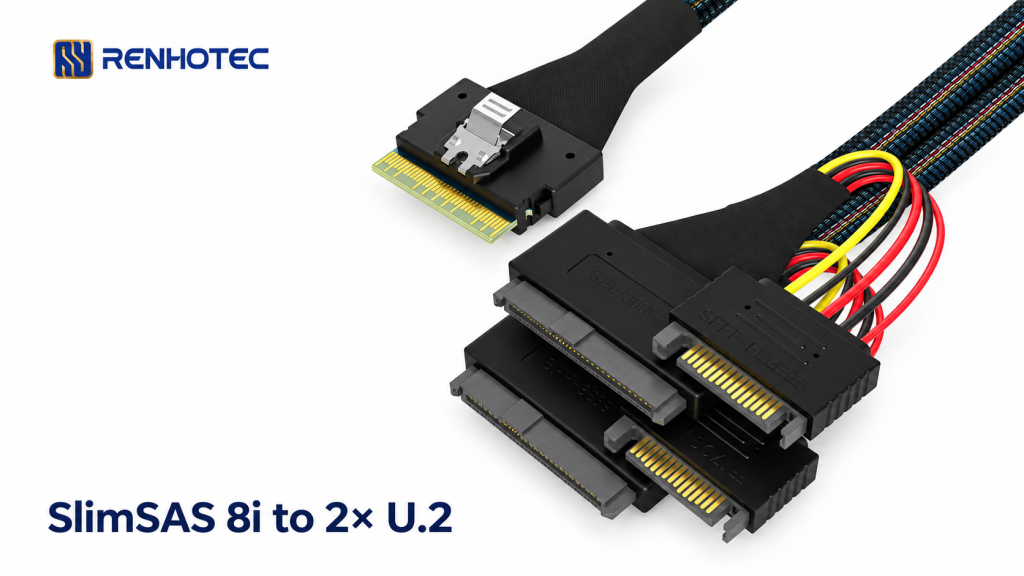
Renhotec RHT-726-1018 is worth shortlisting for two U.2 NVMe SSDs when the host provides two independent PCIe x4 links through one SlimSAS SFF-8654 8i port. The assembly has two U.2 drive ends with mounting ears and a separate 15-pin power connection for each drive. The host pin assignment must match the cable drawing.
Confirm two x4 links at the host
Find the exact SlimSAS connector label on the board and look up that port in the motherboard or controller manual. Check its supported protocol, lane allocation and required cable pinout. “8i” describes the connector configuration; it does not by itself confirm two NVMe drive connections. A port used only for SAS/SATA cannot acquire NVMe support through this cable.
The host documentation must describe two separate x4 PCIe links for this connection. Some platforms expose that arrangement directly; others require a supported bifurcation setting to divide an x8 link into x4/x4. Use the setting for the specific port and board revision. A BIOS menu elsewhere on the board does not prove this port supports the same split.
SNIA’s SFF-9402 Rev 1.1, sections 5 and 6 distinguishes protocol-dependent wiring and separate sideband paths for two independent x4 interfaces. Compare clock, reset and management assignments as well as the high-speed pairs. RHT-726-1018’s drawing is a cable reference; it does not certify a motherboard combination or a particular PCIe generation.
Keep the two drive branches identifiable
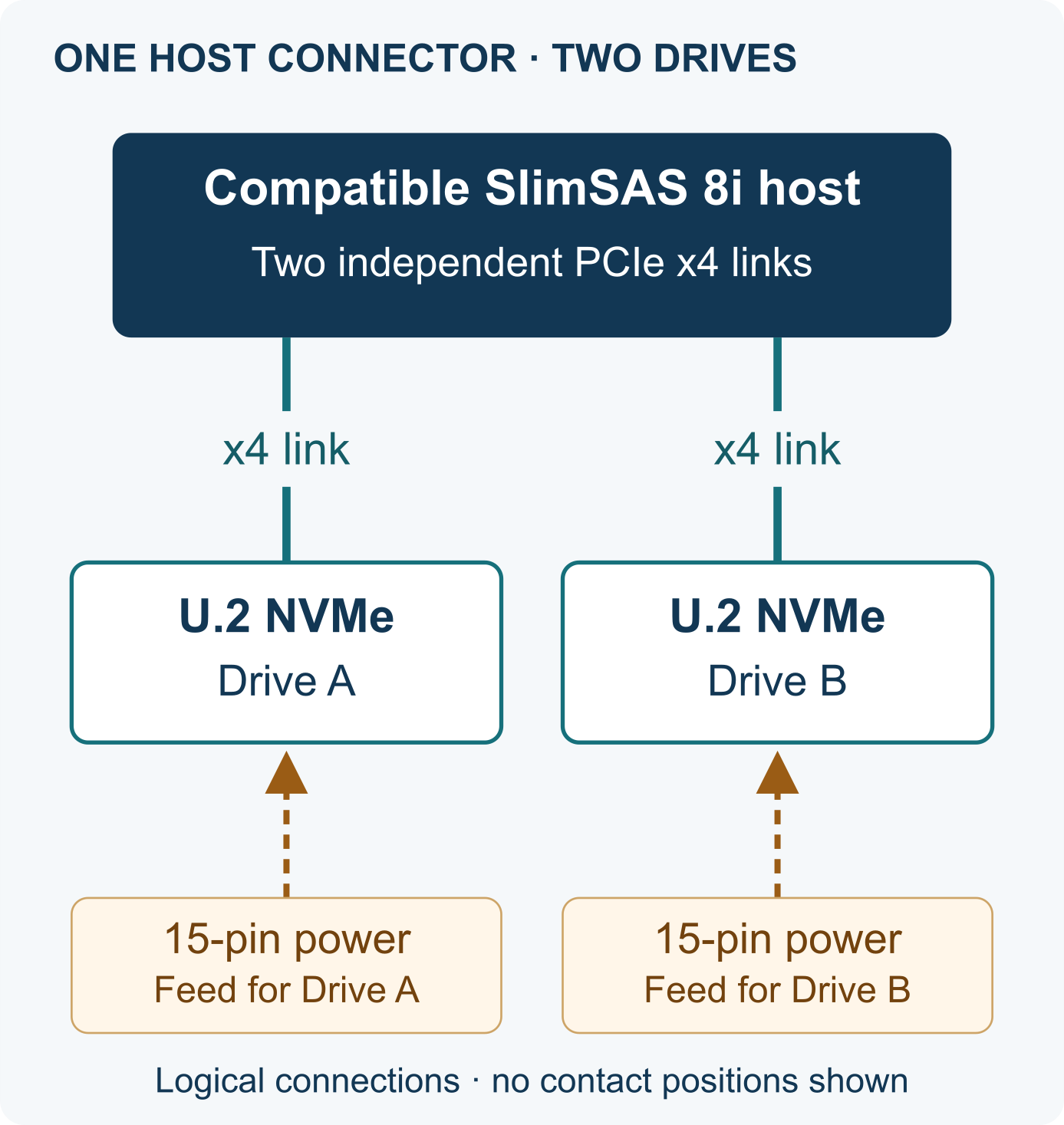
The RHT-726-1018 drawing, R1.0 dated 17 June 2024 labels the SlimSAS end P0. Its two signal tables separate the first and second groups of four lanes:
| Drawing reference | Signal group at P0 | Drive-side connection |
|---|---|---|
| P1 · first U.2 end | PCIe TX/RX 0–3 | Lanes 0–3 at P1; its adjacent power branch is P3 in the assembly view. |
| P2 · second U.2 end | PCIe TX/RX 4–7 | Lanes 0–3 at P2; its adjacent power branch is P4 in the assembly view. |
P0–P4 are drawing references. Identify the delivered branches from their labels or an approved assembly reference before assigning them to drive bays. Record the bay and SSD serial number for each branch; P1 and P2 do not establish operating-system disk names.
If only one drive appears, check whether the host enables both x4 links and whether the missing drive has power. Record which branch and SSD are affected. Any branch swap or power-cycle test should follow the system’s service procedure.
Check both drive positions and both power routes
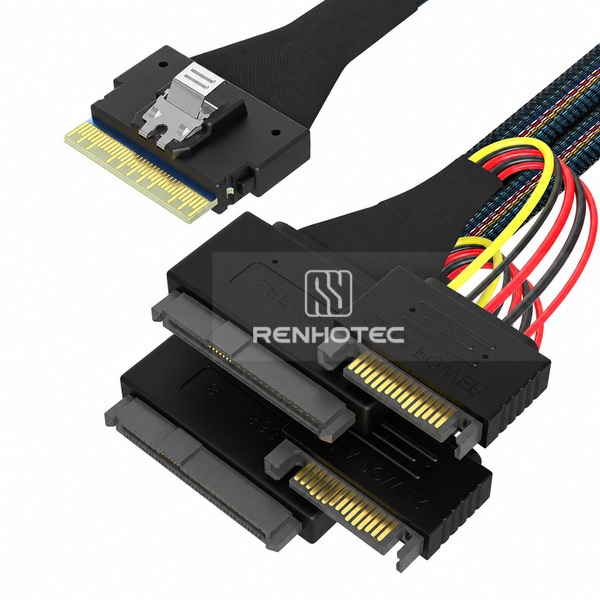
The R1.0 assembly view gives a 500 ±20 mm length between its indicated connector datums. It does not specify the usable distance between two drive bays or the free length of each power branch. Measure the route from the host to each drive position and the route from each power input to the approved supply connection. Send a layout if the drives are separated by a partition or mounted at different heights.
For a fixed carrier, match the U.2 mounting ears to the carrier drawing. The published 60 mm dimension is the overall ear-to-ear span, not the hole-centre spacing. Obtain the mating hole and fastener details before designing the bracket; the ear shape alone does not establish a screw size or tightening torque.
Plan a power connection for each drive. Check the SSD’s required rails and the system supply’s capacity and wiring; a 15-pin connector shape does not establish all of those conditions. Confirm both power connections and the required branch lengths in the order drawing.
Specify the two-drive configuration
For a configuration check on RHT-726-1018, provide the board or controller model and revision, the exact port label, its two-link assignment or supported x4/x4 setting, and both SSD models. Add the two bay positions, each power-feed location, the required routed lengths and the carrier mounting drawing.
Include the target PCIe generation so the proposed assembly and length can be assessed for that requirement. If the host connection is 4i, the application needs only one U.2 end, or the system specifies a different power input, compare the SlimSAS cable configurations before selecting this two-drive part.